
With the growth of a startup company, one of the typical problems arising once a deal is made with an enterprise customer is how well-secured processes and customer data are. This is when SOC 2 can come in handy. It offers clients an independent assessment of controls; however, the audit report is the final product. The initial process includes risk assessment based on the reality of the business.
Understanding the Framework
SOC 2 audit falls into the category of System and Organization Controls, according to AICPA. The audit will be performed on the controls associated with the criteria of the Trust Services – Security, Availability, Processing Integrity, Confidentiality, and Privacy. The Security Criterion applies to all types of audits. Other criteria are selected depending on the relationship between the service and client commitments.
In searching for the framework information, one may find out that SOC 2 audit can also be referred to as Service Organization Controls. The picture is quite clear; controls should relate to the risks, systems, and commitments of the organization. Using a large corporation’s control framework for a startup’s SOC 2 audit would not be appropriate, as the controls should be tailored to the startup’s size, structure, and operational requirements.
Significance of the Assessment
Risk assessment is an effective tool which helps managers to develop a common perception of risks. It is necessary to establish connections between the objectives of the business and technology, people, suppliers, and the process itself. Risk assessment is a rational way of making decisions about measures to be taken for certain risks: accept, mitigate, transfer, or avoid.
The problem becomes significant in the context of SOC 2 compliance in a startup company where resources are limited. Rather than taking all risks into consideration, one considers those which may affect customers, the services offered, the agreements reached, and the consequences of the event.
A Practical Lifecycle
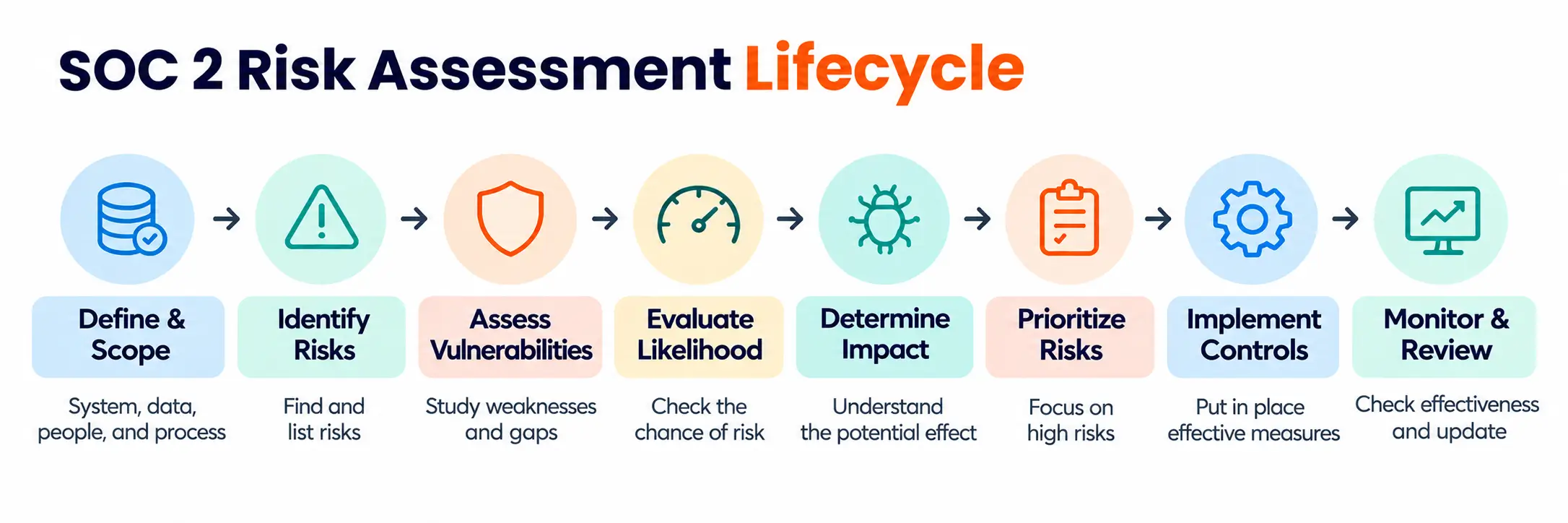
- Identify what the organization wants to secure
Clearly state the goals. They could involve securing customer data, ensuring that an essential platform is available, stopping any access by an unauthorized party, processing data correctly, and fulfilling contractual obligations. If goals are clearly defined, it gives a basis to determine whether a certain threat is significant. - Identification of assets and processes
Identify all systems, data, employees, and processes related to the provision of the service. The examples of those can include databases, cloud accounts, sources of code, computers used by the employees, customers’ data, backup solutions, release processes, and critical suppliers.In case of identifying any asset, four questions should be answered: who is responsible for the asset? How sensitive is the asset? What else does it depend on? What is the impact of its failure or unauthorized change? It will make SOC 2 assessment more specific and avoid generic risks from being used. - Identifying the risks and vulnerabilities
In the next step, think about the events which could impact assets, and what vulnerabilities would lead to the event happening. Examples of such events could include phishing, stolen credentials, malware, excessive privileges, vulnerable APIs, cloud misconfiguration, human error, poor change control, or disruption of a critical vendor. - Probability of the occurrence of risks and its impact
Choose an approach that is straightforward and easily implementable. Many startups assess risks on a scale of 1 to 5 in terms of probability and impact and multiply these numbers. A risk which has a probability of 4 and an impact of 5 will be scored 20.In SOC 2, it is not the calculation that matters, but rather the reasoning behind it. One needs to explain how this number was determined and what its significance is. Apply this approach consistently across risk registers. A well-justified estimation is more valuable than an accurate calculation without any explanation.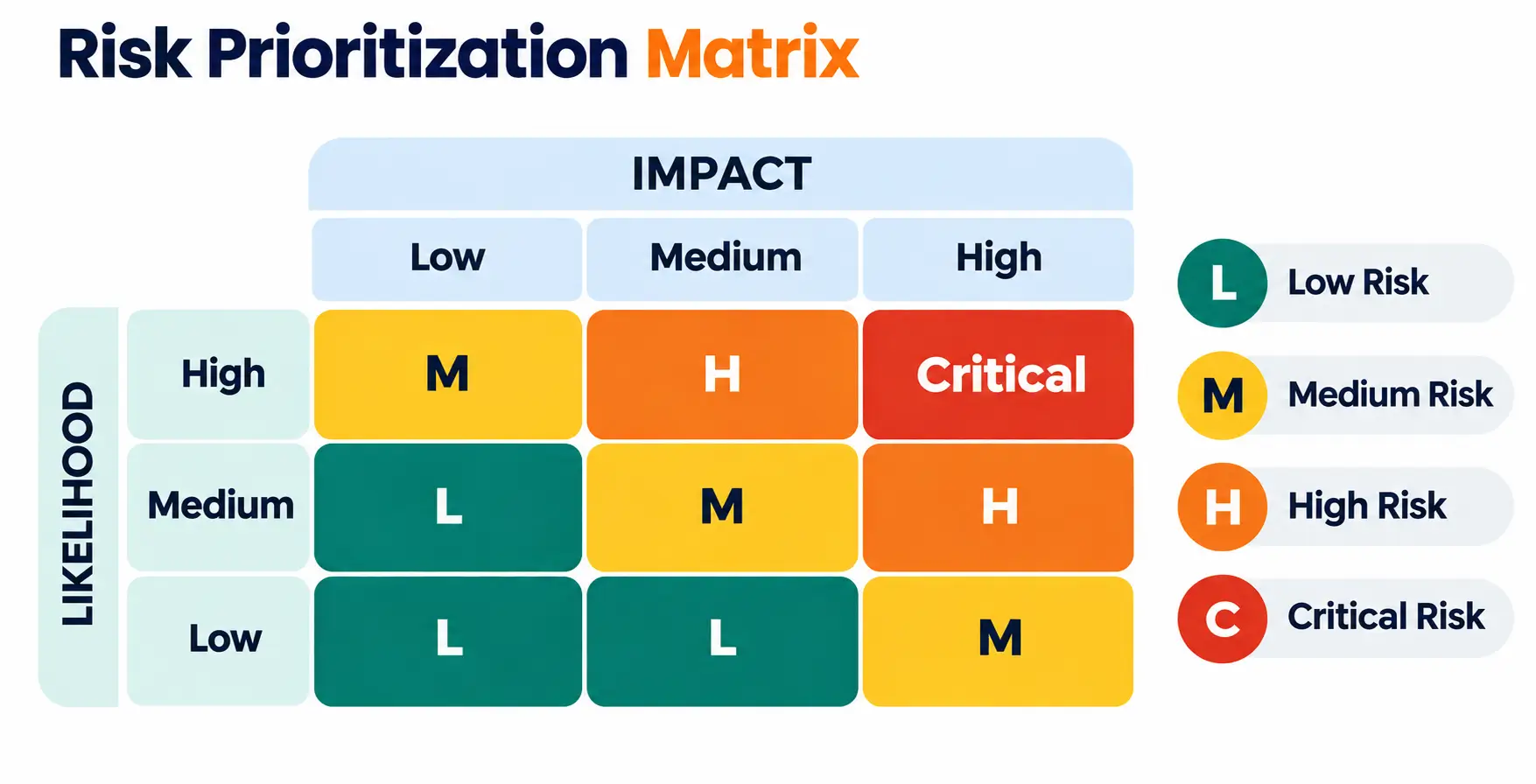
- Analyse control measures and residual risk
Now analyse the existing controls. These may include multifactor authentication, role-based access, encryption, user education, vulnerability management, backups, access reviews, monitoring, and change control.Start by calculating the risk of exposure if there are no controls in place. It is an inherent risk. Calculate the risk of exposure after the controls are applied. It is called residual risk. An extremely dangerous exposure may turn out to be manageable when effective controls are used, but the decision on whether it is acceptable still lies with management.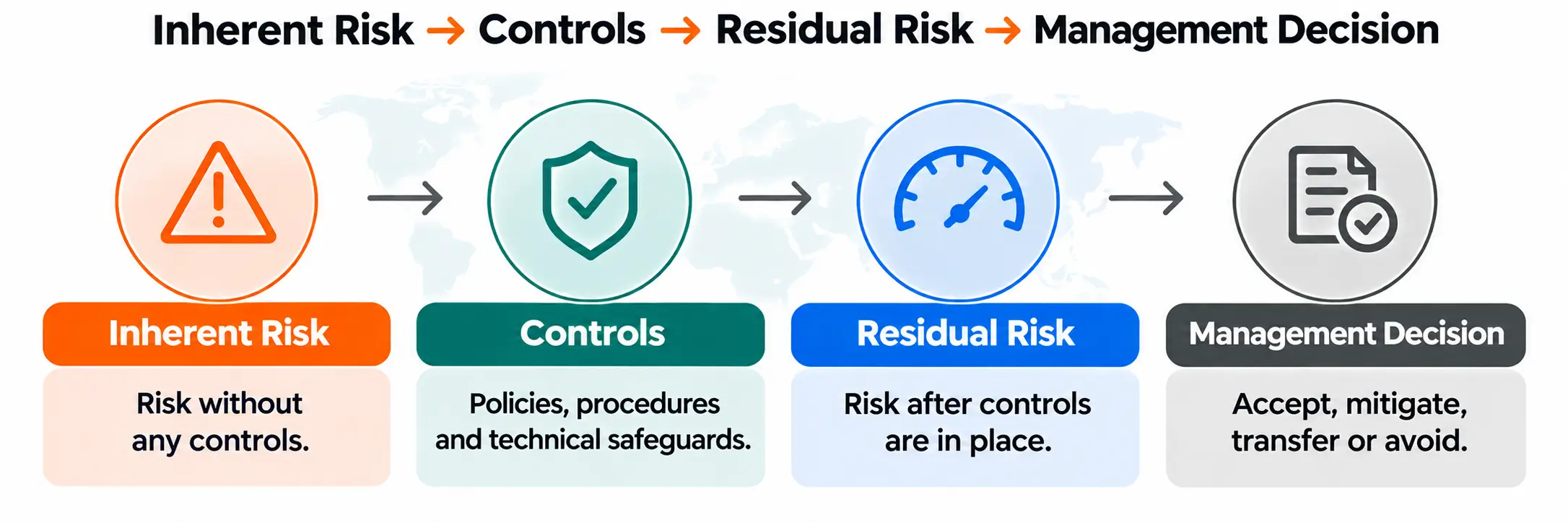
- Address fraud and abuse
Every issue is not necessarily an accident. Think about abuse of privileged access, misusing production data, fraudulent instructions on payments, deliberately skipping approval processes, social engineering, and management override. Review these issues whenever there are changes to responsibilities, systems, or access privileges. - Introduce vendors to the equation
Almost all new ventures rely on cloud computing services, payment systems, collaboration platforms, and software development frameworks. Such engagements can pose risks of security, availability, privacy, continuity of service delivery, access issues, and contractual compliance.Vendor management should be based on the criticality of the vendor. While a low-risk vendor might only warrant a review, a vendor who stores sensitive customer data would need due diligence, contracts, assurance reporting, monitoring, and re-evaluation. It is yet another instance where the System and Organization Controls methodology should follow risk. - Perform reassessment as changes occur
While an annual review is valuable, there is no need to limit it. It may become necessary to perform a reassessment due to a product launch, change in infrastructure, vendor, or even after a security breach.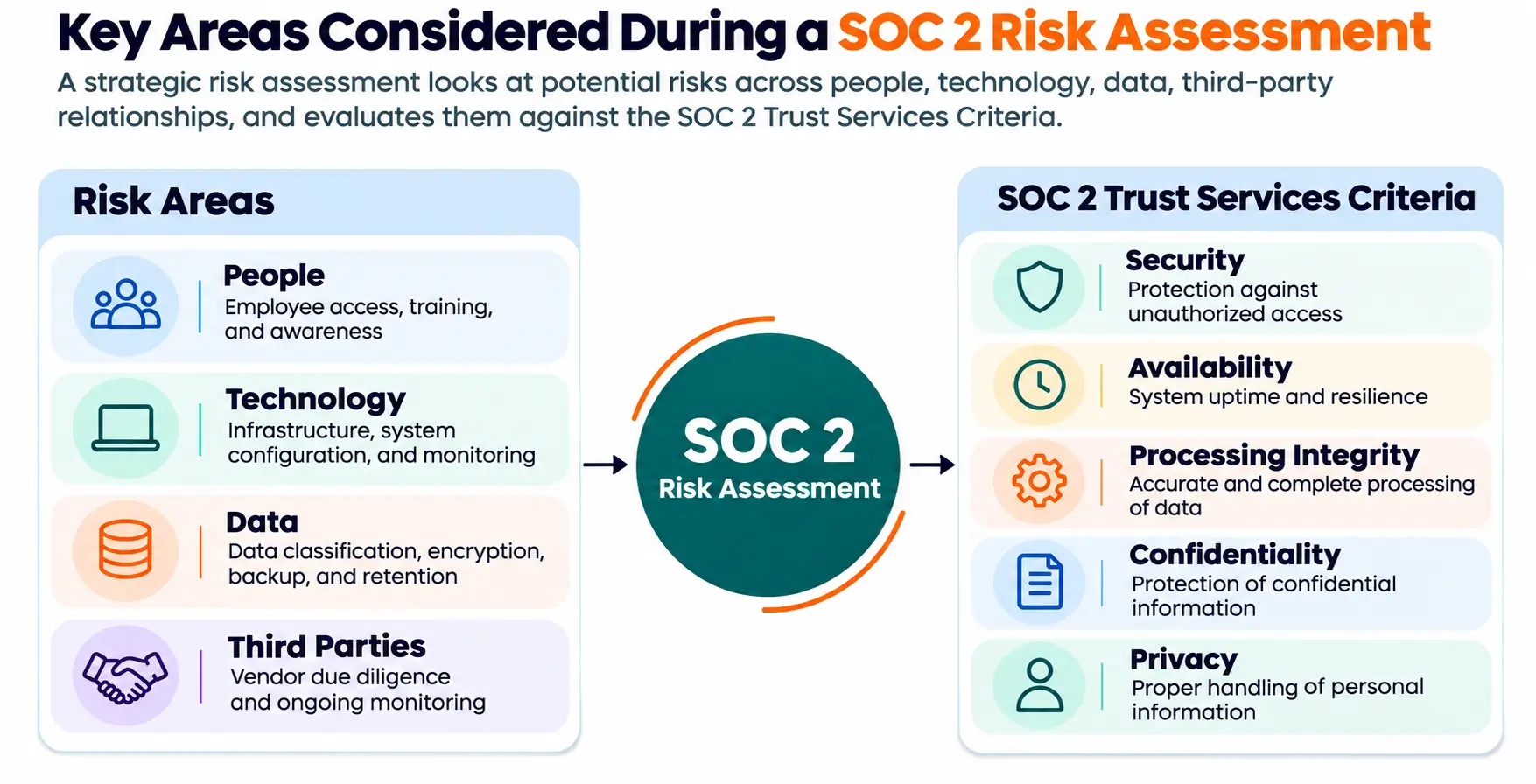
Typical Pitfalls to Avoid
Generic language: A generic risk register might seem fully documented, but it does not show the real exposures.
Controls not linked to the risks: Each major control should address one or more objectives or risks. Otherwise, the team might maintain work that is of minimal value.
Owner and action date missing: Major risks require an owner, action, and a practical target date.
Lack of a view into residual risk: Tracking just the original risk makes it harder to assess whether the controls are working.
Infrequent updates: As products, vendors, risks, and customer requirements change, the risk register must be updated accordingly.
What Makes a Useful Risk Register
Ensure that the risk register is sufficiently comprehensive for the purpose of decision making, yet not too complex to sustain. Some of the factors that it should cover include; risk identification, risk description, risk assets/processes, category, probability, consequence, inherent risk evaluation, existing controls, residual risk evaluation, risk owner, risk treatment decision, action plan, target completion date, status, and next review date.
Making the Process Successful in a Startup
Keep the process simple. A focused workshop with the correct people might serve better than an extensive questionnaire to answer alone. Participants must comprise people who have knowledge of engineering, operations, security, client commitments, and significant vendors.
Every decision made should be recorded. If the decision is approved by management, it must be recorded with the reasons and the details of the person who approved it. Documentation should be done on the treatment plan together with the timeframe agreed on. This will be important in relation to SOC 2 compliance for start-ups and future use. In summary, the findings have to be applied in day-to-day business processes. The most critical issues have to be considered in project planning, security, vendor management, incident response, or business continuity planning. This is where the conversion from SOC 2 risk assessment to management takes place.
Conclusion
Risk assessment offers not only the grounds for an audit but much more. In the first place, it gives decision-makers timely awareness of factors that can affect the delivery of services, their customers, or significant contracts. Risk assessment allows coming up with a rational way to priorities issues.
As for startups that work on SOC 2 compliance, the optimal methodology must be understandable and reproducible. The risks must be defined considering the business; they have to be scored in a consistent manner; control relationships must be established; responsibilities should be defined; and the risk assessment process has to be revised when circumstances change.
SOC 2 is not simply a box-ticking exercise, or a collection of policies stored for an audit. Its value lies in creating a governance framework that supports day-to-day decision-making. By connecting activities like access reviews, change management, vendor assessments, incident response, and business continuity planning to real business risks, organizations can embed SOC 2 principles into operations rather than treating them as something only discussed during audits or sales conversations.
Why Choose soc-audit.com?
At Ascentium India, we combine deep technical expertise with regulatory knowledge to help organizations achieve and maintain compliance effectively. Our team of certified professionals has extensive experience across governance, risk, compliance, cybersecurity, and audit frameworks. We support businesses through security assessments, compliance readiness reviews, risk management, internal audits, cybersecurity testing, and ongoing monitoring, helping them address key risks while building sustainable security and compliance programs. To learn more about our services, write to us at contactus@soc-audit.com.
FAQs
References
- AICPA & CIMA, 2017 Trust Services Criteria with Revised Points of Focus (2022)
- AICPA & CIMA, SOC Suite of Services
- AICPA & CIMA, SOC 2 Reporting on an Examination of Controls at a Service Organization