
In most cases, organisations requesting a SOC 2 attestation focuses only on the policies, processes, and controls, ignoring the significance of technical validation. This is where Vulnerability Assessment and Penetration Testing (VAPT) comes into the picture. Integrating VAPT within SOC 2 controls gives organisations additional assurance that security controls can withstand cyber-attacks.
As cyber-attacks grow more sophisticated, companies need more than documented proof of maturity; they need VAPT as an indispensable part of their SOC 2 framework.
Understanding SOC 2 and VAPT
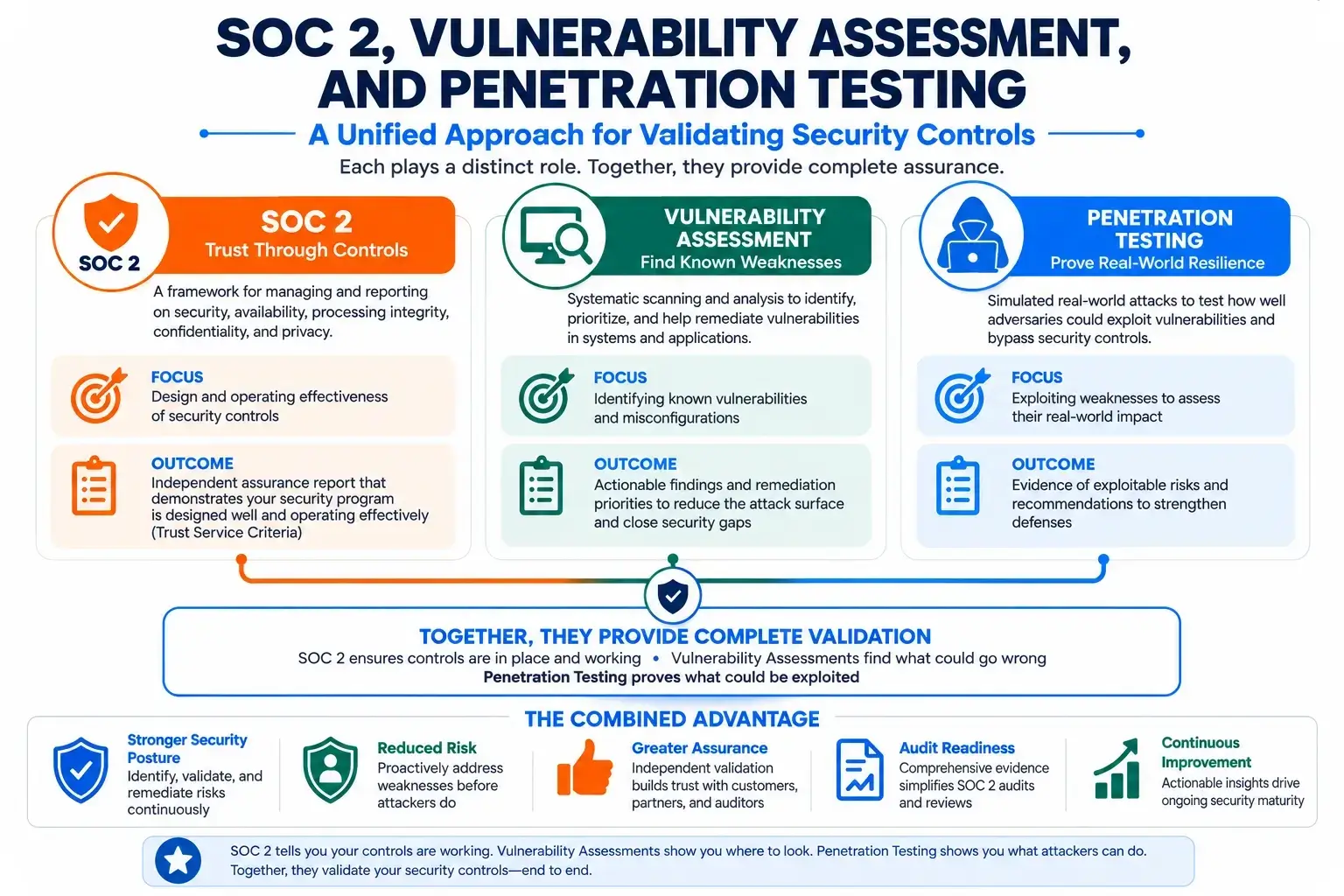
SOC 2 is a security assurance framework that evaluate how organisations manage customer data in compliance with specified security, availability, confidentiality, processing integrity, and privacy criteria. The SOC 2 framework requires implementation of some controls and demonstration of effectiveness.
VAPT is the abbreviation for Vulnerability Assessment and Penetration Testing which evaluates security by running Vulnerability Assessment and Penetration Testing on the system to verify if vulnerabilities can be exploited by malicious actors.
SOC 2 defines the security controls organisations need to have in place, while VAPT evaluates effectiveness through practical testing. Integrating SOC 2 and VAPT provides a comprehensive approach for security assurance and risk management.
Why VAPT Matters for SOC 2 Compliance
Although SOC 2 does not explicitly require a VAPT exercise, its underlying COSO principle of ongoing monitoring and the Trust Services Criteria (TSC) require organisations to monitor controls effectively by continuously identifying risks, assessing vulnerabilities, and putting appropriate controls in place. Vulnerabilities are typically tested through VAPT, and testing systems and applications gives the organisation documented, objective evidence.
The Role of VAPT in Supporting SOC 2 Compliance
Key SOC 2 Controls Enhanced by VAPT
Several areas within the SOC 2 framework can be significantly strengthened through regular VAPT Vulnerability Assessment and Penetration Testing activities.
Access Control Validation
One of the primary requirements for the fulfilment of SOC 2 compliance is access control, and it can be demonstrated through penetration testing. This especially includes the capability of access controls, privileged accounts, role-based controls, and authentication controls from preventing unauthorised access.
Vulnerability Management
SOC 2 compliance requires an organisation to be able to identify risks and mitigate them. Regular Vulnerability Assessment practice is useful for proving this capability.
Incident Detection Readiness
Continuous VAPT testing practice allows security teams to test ability to detect incidents and response effectiveness.
Infrastructure Security
A common setup currently will be reliant on the cloud platform infrastructure and each of the systems tied into together. Vulnerability Assessment and Penetration Testing can confirm whether the infrastructure is secure.
The VAPT Journey to SOC 2 Readiness
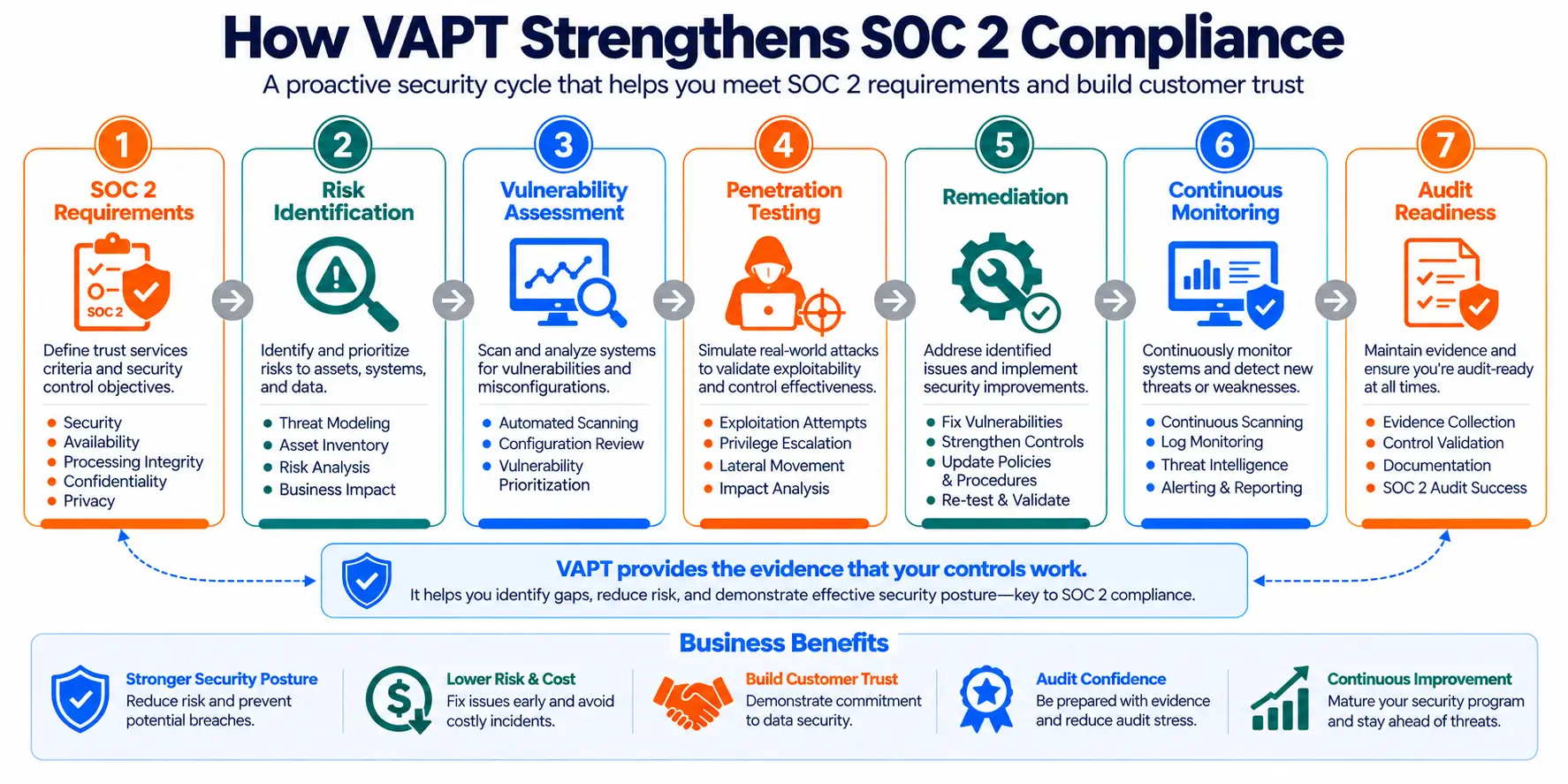
VAPT also supports key Trust Services Criteria related to risk assessment, logical access, system operations, and continuous monitoring, which are aligned with the COSO framework used within SOC 2 audits.
Best Practices for Integrating VAPT into SOC 2
A structured VAPT program helps organisations validate security controls, prioritise remediation efforts, and strengthen SOC 2 audit readiness.
Conduct VAPT According to Risks Identified
The organisation should perform VAPT testing activity in context of any business or security risk which has been identified. This will permit the organisation to perform tests on key assets pertinent to SOC 2 compliance.
Schedule Tests Regularly
An annual VAPT test may no longer be sufficient for organisations. Vulnerability assessment shall be performed routinely, ideally on a quarterly basis and whenever any significant change in the infrastructure is made. Penetration testing should be performed minimum on an annual basis and/or whenever the major application/ network / cloud infrastructure changes occur.
Conduct VAPT Internally as Well as Externally
While conducting Vulnerability Assessment and Penetration Testing, the organisation should conduct it internally and externally too. It will be beneficial for SOC 2 audit.
Focus On Business Impact
The findings from the VAPT assessment should be categorised and remediation efforts should be carried out based on it. Effective remediation is very important.
Maintain Documentation
Documentation of every VAPT, remediation, and retest activities is necessary. It will help in SOC 2 audits
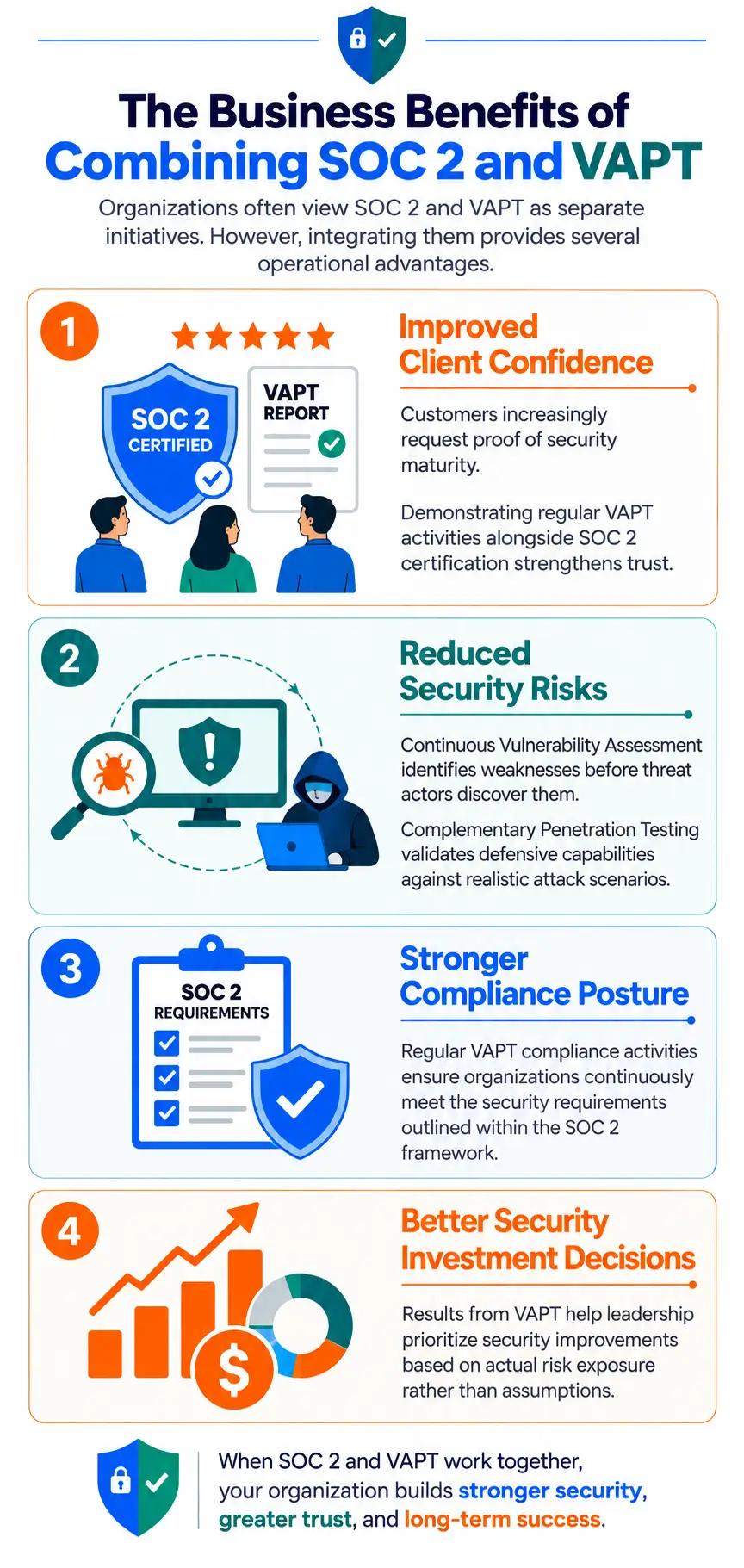
The Strategic Benefits of Aligning SOC 2 with VAPT
Common VAPT Findings Affecting SOC 2 Audits
Common critical findings that affect organisations pursuing SOC 2 compliance include:
- Weak passwords
- Missing security updates
- Excessive administrative admin privileges
- Misconfigured cloud storage
- Insecure APIs
- Lack of network segmentation
- Insufficient monitoring controls
Addressing these findings improves the SOC 2 posture and strengthens the organisation’s overall security resilience. To provide tangible assurance, VAPT should use sound methodology with a clearly defined scope that covers all critical servers and applications. It should also include retesting to confirm that flaws have been fixed, along with clear reports that support the audit.
Building a Continuous VAPT Programme
Instead of running isolated tests aimed only at compliance, companies need to implement a continuous VAPT testing programme.
The components of such a programme will include the following:
- Vulnerability Assessment scans
- Penetration Testing
- Verification of remediation
- Reporting on risks
- Executive dashboards
- Security metrics tracking
Such an approach helps to keep up with SOC 2 compliance requirements while responding to cyber threats. Organisations that incorporate VAPT and penetration testing into governance efforts tend to have smoother SOC 2 audits.
Conclusion
SOC 2 compliance is more than just implementation of controls. Organisations need to show that those controls are working effectively against the backdrop of evolving cybersecurity threats. The inclusion of VAPT testing, Vulnerability Assessment and Penetration Testing to the SOC 2 lifecycle gives organisations better risk visibility, enhanced security resilience and improved audit readiness.
As cyber risks are constantly evolving, organisations who embrace continuous VAPT programmes as part of SOC 2 strategy are better placed to protect the critical assets, meet customer expectations, and sustain compliance in the long run.
Why Choose soc-audit.com?
At Ascentium India, we combine deep technical expertise with regulatory knowledge to help organisations achieve and maintain compliance effectively. Our team of certified professionals (CISA, CDPSE, FCA, and LLB) has extensive experience across governance, risk, compliance, cybersecurity, and audit frameworks. We support businesses through security assessments, compliance readiness reviews, risk management, internal audits, cybersecurity testing, and ongoing monitoring, helping them address key risks while building sustainable security and compliance programs. To learn more about our services, write to us at contactus@soc-audit.com.
Disclaimer
This blog provides general information about cybersecurity, SOC 2, VAPT, Vulnerability Assessment and Penetration Testing practices and should not be treated as legal, regulatory, or professional advice. Organisations should consult qualified legal, compliance, and cybersecurity professionals to address specific business requirements and risk environment.