
SOC reports do not make for exciting conversation and most people in the room will admit they’d rather be elsewhere the moment the topic arises. Yet the quiet cost of not having one can be far greater than anyone anticipates. Time and again, a well-qualified deal stalls at the security assessment stage and the reason isn’t pricing, it isn’t product fit — it is simply that a current SOC report was not ready when it needed to be.
What is SOC Reporting?
SOC stands for Service Organization Controls or, more formally, System and Organization Controls. It is the standard issued by the AICPA that provides the gold standard in financial and operational assurance and addresses how clients know that controls work.
A SOC report is prepared by a licensed, independent professional who evaluates and tests an organization’s systems and processes and then delivers a formal report outlining findings and professional opinion. It is not a self-attestation, but an actual test of systems and processes by a professional.
A SOC Type 2 report goes beyond confirming that controls are designed and implemented — it verifies operational efficiency throughout the specified period.
Types of SOC Reports
SOC 1: Financial Reporting Controls
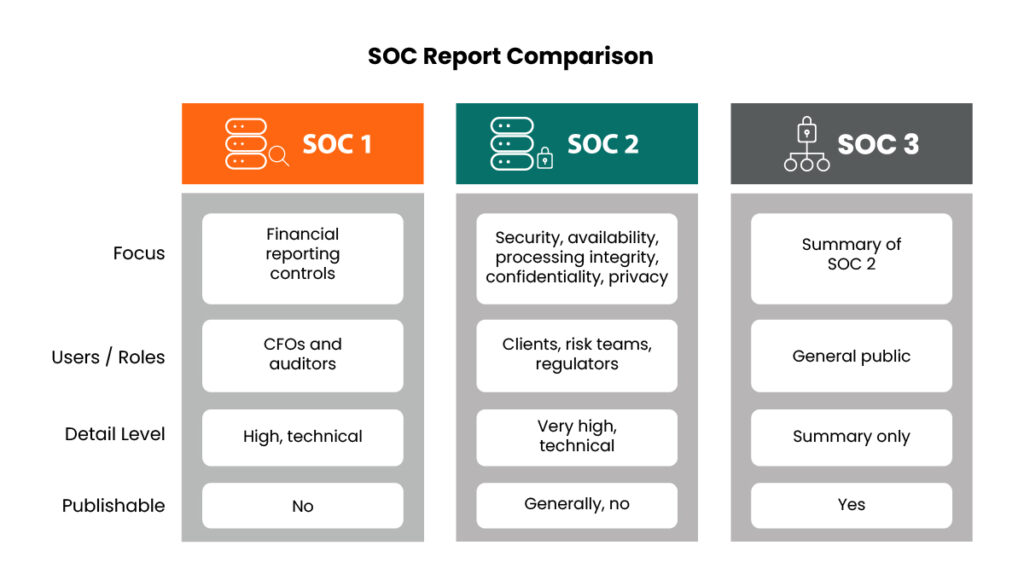
SOC 1 is for service organizations whose controls relate to clients’ financial statements. Payroll processing companies, loan servicing companies, fund administrators, and back-office transaction handlers typically need this report. It is intended for clients’ CFOs and external auditors.
SOC 2: Tech and SaaS Standard
SOC 2 is necessary for almost all technology and SaaS providers. It follows five Trust Services Criteria: Security, Availability, Processing Integrity, Confidentiality, and Privacy. These reports are frequently requested in vendor questionnaires and contract negotiations; deals often stall without a SOC 2 report.
SOC 3: The Public Summary
SOC 3 uses the same methodology as SOC 2 but with less technical detail. It is suitable for marketing purposes and preliminary vendor qualification.
Type I vs. Type II
All SOC reports are issued as either Type I or Type II.
- Type I is a snapshot of the control design at a specific point in time. It is useful for evaluating design and identifying gaps.
- Type II covers a defined period (typically 6–12 months) and demonstrates that controls operated effectively throughout that period. Most stakeholders prefer Type II reports.
What is the Process of a SOC Audit?
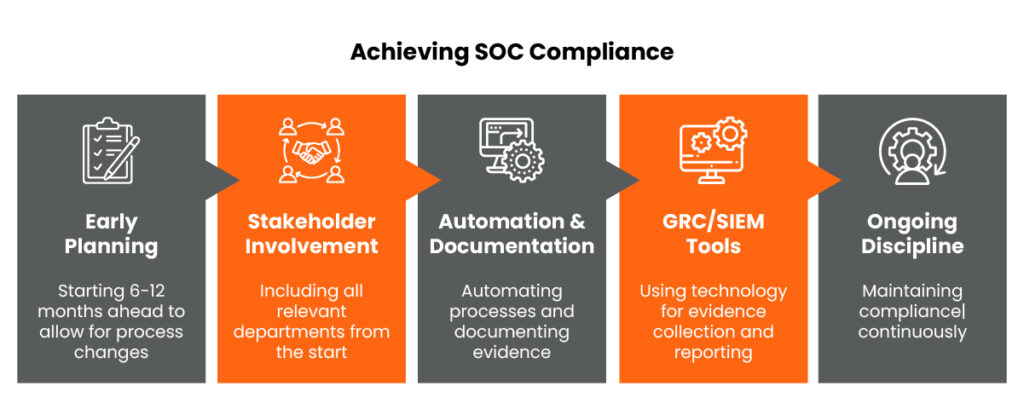
The smartest organizations view SOC audit and reporting as an ongoing strategic program rather than a last-minute reaction to client requests.
Before the SOC Audit
A readiness assessment is typically carried out first. It reveals internal control and process issues (such as former employee accounts not properly disabled, untested disaster recovery plans, or weak vendor controls) so they can be fixed before the real audit.
During the SOC Audit
Auditors examine evidence including change tickets, access logs, and test documentation. A successful audit includes a detailed system description, the auditor’s opinion, and test results.
After the SOC Audit
During the period between reports, clients often request a management representation letter (bridging letter) confirming that no significant changes have occurred since the last report.
Beyond the Certificate: What a SOC Audit Really Uncovers
Beyond the report itself, a SOC audit identifies weaknesses in access controls and procedures. These findings can be mapped to other frameworks such as NIST and ISO 27001, and an up-to-date report helps accelerate deal cycles by reducing late-stage security due diligence delays.
Conclusion
A SOC report is more than just an audited certificate; it is proof that an organization takes System and Organization Controls seriously. Lack of current SOC reporting is a major warning signal to clients, partners, and regulators. Organizations with effective SOC reporting treat it as an ongoing process so they are always ready for new business opportunities and emerging threats.
Why Choose Ascentium?
We provide end-to-end privacy, cybersecurity, and information security support, including privacy and information security gap assessments, compliance programme design, Data Protection Officer services, information security and cybersecurity assessments, vendor due diligence, security and privacy risk assessments, consent management, breach and incident response planning, and ongoing compliance monitoring. Our customised approach helps organisations identify and prioritise high-risk areas, strengthen their privacy and information security posture, enhance cybersecurity resilience, and build sustainable frameworks that adapt to evolving regulatory and security requirements across markets. To learn more about our services, write to us at contactus@soc-audit.com.
Disclaimer: This article provides general information and should not be treated as legal advice. For guidance specific to your situation, consult with qualified legal and technical professionals.